Restoration
Assessment: understanding the site before intervening
A key first step in peatland restoration is a comprehensive assessment of the site conditions.[1],[2] By monitoring and analyzing the site conditions, restoration practitioners can identify the prominent stressors, quantify their impacts, and develop goals to restore the site. The assessment should describe the current conditions and, if possible, the pre-degraded functioning of the site.[1]
Pre-degradation conditions
Determining pre-degradation conditions of a peatland provides an idea of the undisturbed functioning of the site. Knowing the site’s undegraded condition allows restorationists to set targets and determine how restoration can be evaluated. In general, pre-degradation information can be derived from two sources:
-
Palaeoecology - micro and macro-fossils found in the peat can be used to reconstruct historic ecological interactions between biota and the respective environments.[3]
-
Historical records - maps, satellite images, photos, taxonomic collections, and written and oral accounts can provide insight into the historical functioning of the site.[4],[1],[2]
There are several limitations with acquiring and interpreting this information. First, there is often minimal information on the historical conditions of peatlands. This is especially true in areas with long histories of anthropogenic land-use change (e.g., Central Europe), making it difficult to acquire an accurate idea of the original peatland functioning.[5] If information is available, the pre-degraded state may no longer be achievable. For example, soil conditions in extracted peatlands often differ significantly from the original conditions, making rewetting an unviable restoration option.[6] Restoration should therefore focus not on restoring historical conditions, but rather on using knowledge of these conditions to restore the achievable function of the peatland.[7]
Current conditions
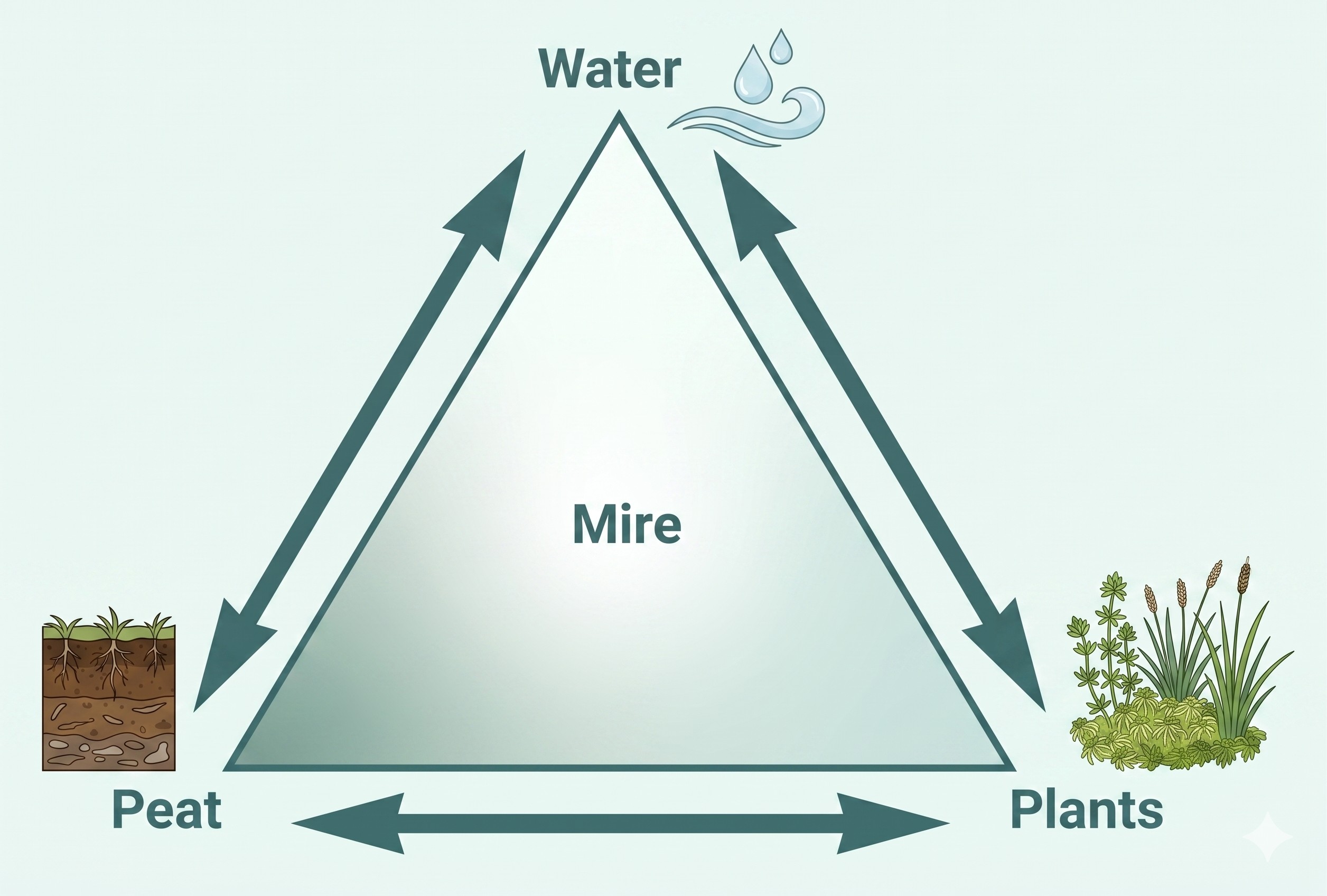
Determining the current conditions of a degraded peatland requires an assessment of three key components: hydrology, peat, and vegetation. These variables are interdependent, meaning a change in one causes a change in the other two.[8],[9] The hydrology influences which plants will grow; the plants, in turn, determine the type of peat that forms; and the structure and type of peat regulates the flow and storage of water in the peatland.[2] By assessing each of these components, restoration practitioners can determine the extent to which the peatland is degraded and develop clear and achievable restoration goals.
Hydrology
Altered hydrology is the primary problem to address in peatland restoration, and thus the most important step in assessing a degraded peatland.[8] Key parameters to measure are the water table level and water table fluctuations throughout the site,[8],[2] as these characteristics determine the status of the peat layer and the vegetation on-site.[10] The hydrology assessment should also record the amount and type of precipitation, the presence of drainage structures (e.g., ditches, pipes), topography (e.g., slope, microtopography), and the direction of water flow.
The hydrologic regime of peatlands is rarely isolated from the surrounding area. External factors, like upslope agricultural areas with drainage tiles or irrigation lines, can disrupt the groundwater influx to the peatland. Any hydrological restoration to the degraded peatland will be ineffective unless the off-site issues are addressed. Hydrological assessments should therefore incorporate the greater catchment area, including land-use and associated drainage networks.[8],[5],[11]
Water quality and chemistry parameters (e.g., pH, electrical conductivity) should also be measured, as these conditions influence which plants occur and the peat that accumulates.[12] For example, if the groundwater is acidic with a pH < 5, restoring the site towards bog conditions is more realistic and feasible than towards fen conditions.[1] These parameters should be measured both at the degraded site and, for groundwater-fed peatlands (i.e., fens, swamps), at the groundwater source.
Peat
An assessment of the peatlayer is important, as it provides insight into the peatland functioning and what restoration options can improve this function. Thin decomposed peat layers, associated with drained peatlands, have a lower water storage capacity, making the establishment of water-reliant species such as Sphagnum mosses less likely.[1] Further, decomposition can reduce the distance between the sub-peat soil and the surface layer, favouring the establishment of non-peatland plant species. By measuring peat parameters, restoration practitioners can determine the level of degradation and the feasibility of different restoration options (e.g., re-establishing the Sphagnum community). Important peat parameters to measure include the degree of decomposition (using the Von Post scale), water content, surface level changes, and peat erosion.[13]
The Von Post scale is a 10-step system for classifying peat decomposition, from H1 (completely undecomposed, intact plant structure) to H10 (fully decomposed, no identifiable plant structure). The test involves hand-squeezing a peat sample and observing the colour, turbidity, and texture of extruded water and the remaining material. As peat condition is generally a good indicator of peatland health, due to its interdependence with water and vegetation,[16] the level of decomposition serves as a reliable proxy for peatland condition.
In addition to physical properties of peat, chemical analysis of nutrient concentrations can provide further insight into peatland functioning. Degraded peatlands near agricultural areas are often extremely nutrient-rich, due to peat mineralisation, use of chemical fertilisers, and manure from livestock.[8] Rewetting of a nutrient-rich peatland can cause internal eutrophication The release of nutrients stored in peat under the anoxic conditions created when the water table is raised. Phosphorus in particular is mobilised from iron complexes under reducing conditions. Can temporarily suppress the establishment of target oligotrophic (nutrient-poor) plant communities following rewetting. , a process in which anoxic conditions associated with the high water table lead to the mobilisation of nutrients bound to the peat layer,[7] favouring the establishment of fast-growing, non-peatland plant species.[8] Nutrient analysis should incorporate the greater catchment area to determine if external nutrient enrichment will continue.
Vegetation
A vegetation assessment provides further insight into the peatland condition and function. As it is generally not feasible to conduct an inventory of all plants on site, indicator species are often monitored to obtain a representative assessment of the peatland vegetation with less sampling intensity.[8] If indicator species associated with peatlands (e.g., Sphagnum spp. for bogs or Carex spp. for fens) are present, restoration to conditions that support these species is more likely to be achievable. Species associated with drier conditions (e.g., ericaceous shrubs) indicate a disruption of the water table.[14] If invasive species are present (e.g., Spiraea tomentosa, an invasive species that threatens bog communities in Europe)[15], restoration decisions should incorporate management of these species.
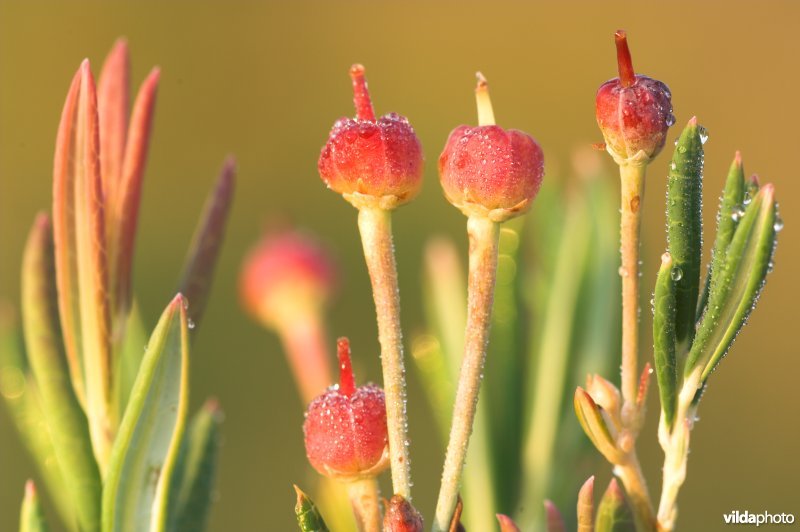
In addition to on-site vegetation, the viability and composition of the seed bank The viable seed reservoir present in a soil. should be monitored to understand the potential of natural vegetation following restoration (i.e., rewetting).[8] If the seed bank on site is not viable, supplementary vegetation management will likely be required as a part of the restoration plan. The assessment of live vegetation and the seedbank should incorporate the degraded peatland and the larger area. For example, if invasive species are identified off-site, their potential impact on restoration should be considered. Additionally, desirable vegetation and seed banks in the surrounding area can serve as donor material for restoration that requires planting or sowing of seeds.[1]
Assessment integration: identifying stressors and degradation level
The data collected during the assessment of site conditions can be compiled and analysed to determine the primary stressors, their negative effects on peatland functioning, and ultimately the level of degradation on-site. Degraded peatlands are often impacted by multiple, interacting stressors. For example, agricultural land use can lead to drainage of peatlands and nutrient enrichment, each requiring different considerations during restoration.
When evaluating the impact of stressor A natural or anthropogenic pressure that causes a quantifiable change, whether positive or negative, in biological response. , it is important to consider that peat, hydrology, and vegetation react to degradation at different rates.[8] In a drained peatland, hydrology and vegetation experience immediate impacts, with aquatic plant species being unable to survive in the dry conditions, while peat decomposes slowly with less immediate impacts. Considering the differing responses of peat, hydrology, and vegetation to different stressors during the site assessment provides practitioners with the necessary information to begin the restoration planning process.
| Stressors | Associated land use | Primary impacts on peatland function |
|---|---|---|
| Drainage | Agriculture, forestry, peat extraction, livestock, infrastructure development |
|
| Nutrient enrichment | Agriculture, livestock grazing |
|
| Invasive plant species | Agriculture, forestry, peat extraction, infrastructure development |
|
- Quinty, F., & Rochefort, L. (2003). Peatland Restoration Guide, second edition. Canadian Sphagnum Peat Moss Association and New Brunswick Department of Natural Resources and Energy. Québec, Québec. ↑ Assessment ↑ Pre-degradation conditions ↑ Historical records ↑ Water quality ↑ Peat ↑ Seed bank
- Schumann, M., & Joosten, H. (2008). Global peatland restoration: A manual for policy makers and site managers. Institute of Botany and Landscape Ecology, University of Greifswald. ↑ Assessment ↑ Historical records ↑ Current conditions ↑ Hydrology
- Birks, H. J. B. (2008). Paleoecology. In Encyclopedia of Ecology (pp. 2623–2634). Elsevier. https://doi.org/10.1016/B978-008045405-4.00525-5 ↑ Pre-degradation conditions
- Gann, G.D., McDonald, T., Walder, B., Aronson, J., Nelson, C.R., et al. (2019). International principles and standards for the practice of ecological restoration. Second edition. Restoration Ecology 27 (S1). https://doi.org/10.1111/rec.13035 ↑ Historical records
- Gorham, E., & Rochefort, L. (2003). Peatland restoration: A brief assessment with special reference to Sphagnum bogs. Wetlands Ecology and Management 11(1): 109–119. https://doi.org/10.1023/A:1022065723511 ↑ Pre-degradation conditions ↑ Hydrology (catchment area)
- Eiseltová, M. (2010). Restoration of Lakes, Streams, Floodplains, and Bogs in Europe: Principles and Case Studies (Vol. 3). Springer Netherlands. https://doi.org/10.1007/978-90-481-9265-6 ↑ Pre-degradation conditions
- Lamers, L. P. M., Vile, M. A., Grootjans, A. P., et al. (2015). Ecological restoration of rich fens in Europe and North America: From trial and error to an evidence-based approach. Biological Reviews, 90(1). https://doi.org/10.1111/Brv.12102 ↑ Pre-degradation conditions ↑ Peat — internal eutrophication
- Convention on Wetlands. (2021). Global guidelines for peatland rewetting and restoration. Ramsar Technical Report No. 11. Gland, Switzerland: Secretariat of the Convention on Wetlands. ↑ Current conditions ↑ Hydrology (primary problem) ↑ Hydrology (water table) ↑ Hydrology (catchment area) ↑ Peat (nutrient-rich) ↑ Peat (fast-growing species) ↑ Vegetation (indicator species) ↑ Seed bank ↑ Stressors
- Minayeva, T. Yu., Bragg, O. M., Sirin, A. A. (2017). Towards ecosystem-based restoration of peatland biodiversity. Mires and Peat, 19, 01. https://doi.org/10.19189/MAP.2013.OMB.150 ↑ Current conditions
- Pakalne, M., Etzold, J., Ilomets, M., et al. (2021). Best Practice Book for Peatland Restoration and Climate Change Mitigation — Experiences from LIFE Peat Restore Project. ↑ Hydrology (water table)
- Similä, M., Aapala, K., & Penttinen, J. (2014). Ecological restoration in drained peatlands: Best practices from Finland. Metsähallitus Natural Heritage Services. ↑ Hydrology (catchment area)
- Parish, F., Sirin, A., Charman, D., Joosten, H., Minayeva, T., Silvius, M., & Stringer, L. (2008). Assessment on Peatlands, Biodiversity and Climate Change: Main Report. Global Environment Centre and Wetlands International. ↑ Water quality
- Thom, T., Hanlon, A., Lindsay, R., Richards, J., Stoneman, R., & Brooks, S. (2019). Conserving Bogs: The Management Handbook. IUCN UK Peatland Programme. ↑ Peat (parameters)
- Bufkova, I., Krenova, Z., & Bastl, M. (2021). Ten years of changes in hydrology and vegetation in montane mires of temperate zone in Central Europe (Šumava National Park). 27, 17–48. ↑ Vegetation (drier conditions)
- Dajdok, Z., Nowak, A., Danielewicz, W., Kujawa, P.-J., & Bena, W. (2011). Invasive Alien Species Fact Sheet Spiraea tomentosa. NOBANIS. ↑ Vegetation — invasive species
- Bonnett, S. A. F., Ross, S., Linstead, C., & Maltby, E. (2009). A review of techniques for monitoring the success of peatland restoration. Natural England Commissioned Report, NECR086. Natural England. ↑ Von Post scale