Restoring natural floodplains
What is a floodplain?
A floodplain is the low-lying land adjacent to a river that is shaped by the continuous interaction between river flow, sediment transport, topography, soils and living organisms. Rather than being static landscapes, floodplains are dynamic systems that evolve through natural flooding and sediment deposition over time.[1] They form the transition zone between aquatic and terrestrial ecosystems and are among the most productive and biologically diverse landscapes in Europe.[2],[3]
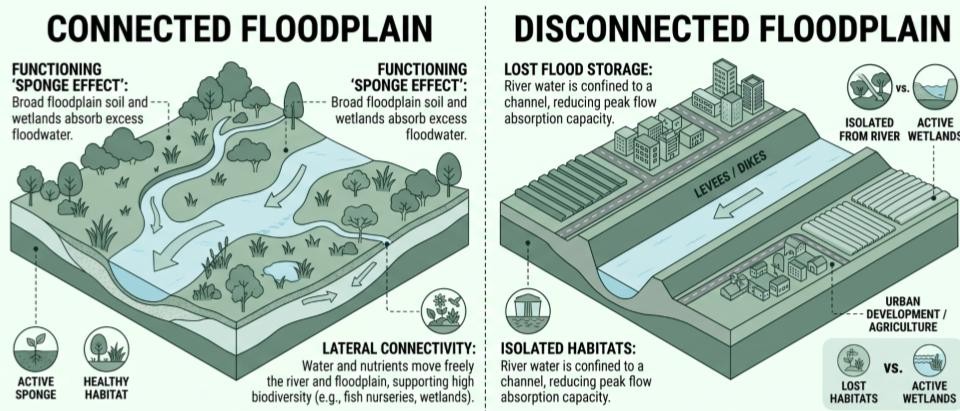
A defining characteristic of a healthy floodplain is its lateral connectivity with the river. In a naturally functioning system, water, sediment, nutrients and organisms can move freely between the river channel and the surrounding floodplain, supporting the ecological and hydrological processes that sustain both ecosystems.[4],[1]
Why floodplains matter
Connected floodplains provide a wide range of ecosystem services that benefit both nature and society. During periods of high river discharge, they temporarily store excess water, slowing flood waves and reducing flood levels downstream.[1] This natural buffering capacity is an important component of sustainable flood risk management.
Floodplains also improve water quality by trapping sediments, retaining nutrients and filtering pollutants before they enter downstream waters.[4],[1],[5] At the same time, they provide essential habitats for aquatic and riparian species, supporting biodiversity and maintaining ecological connectivity across the landscape.[1],[4]
Because floodplains combine flood regulation, water purification and biodiversity conservation within the same landscape, they play a key role in building resilient river basins and adapting to climate change.[2],[4]
How floodplains have been disconnected
Over the past century, many European rivers have been heavily modified to support flood protection, navigation, agriculture and urban development. Levees and dikes, river channelisation and straightening, dams and other flow regulation structures, together with urban expansion and land-use change, have progressively disconnected rivers from their floodplains.[1] As a result, water, sediment and nutrients can no longer move naturally between the river and its floodplain. This loss of connectivity reduces the floodplain’s capacity to store floodwater, degrades riparian habitats and weakens many of the ecosystem functions on which people and nature depend.[3],[1] To support land-use planning and reduce flood risks, floodplains are often classified into different hydraulic zones. These classifications help authorities assess flood hazards, guide spatial planning and identify areas where development should be restricted.[6]
What restoring floodplains means
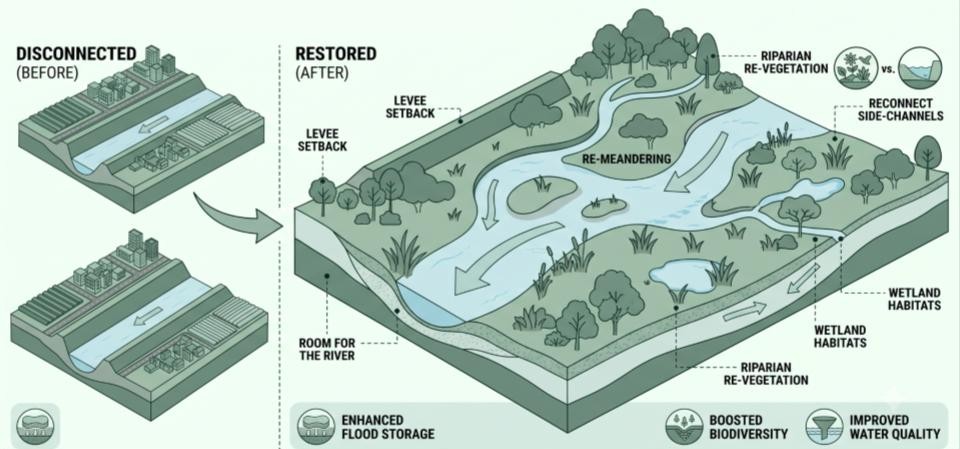
Floodplain restoration aims to re-establish the natural connection between rivers and their floodplains, allowing ecological and hydrological processes to function again. The objective is not simply to recreate historical conditions, but to restore the natural dynamics that underpin healthy and resilient river systems. Depending on local conditions, restoration measures may include setting back or removing levees and dikes, reconnecting side channels, restoring natural flooding regimes, or implementing nature-based solutions such as Room for the River approaches.[1] By restoring lateral connectivity, these measures increase natural water storage, improve water quality, enhance biodiversity and strengthen the resilience of river basins to climate change and extreme weather events.[1],[4],[5],[7]
Contribution to EU restoration objectives
The restoration of floodplain functions complements the ambition to restore free-flowing rivers by addressing the connection between rivers and their surrounding landscapes. While the Water Framework Directive recognises the importance of hydromorphological processes, it does not explicitly require the restoration of lateral connectivity between rivers and floodplains when ecological status can be achieved without it. The Nature Restoration Regulation strengthens this aspect by requiring Member States to restore degraded ecosystems and improve the ecological functioning of river-floodplain systems.
The Habitats Directive (92/43/EEC) has played an important role in protecting valuable floodplain habitats, such as alluvial forests and floodplain meadows, mainly within the Natura 2000 network. However, its focus is primarily on designated habitats and species. The Nature Restoration Regulation expands this ambition by requiring restoration efforts beyond protected areas, creating opportunities to restore ecological processes and habitat networks at the landscape scale.
Floodplain restoration is also closely linked to European climate objectives. Under the Land Use, Land Use Change and Forestry (LULUCF) Regulation (EU) 2018/841, amended by EU 2023/839, Member States have commitments to maintain and increase carbon removals from land use. Healthy floodplains, wetlands and floodplain forests can contribute to these goals by storing carbon and maintaining important ecosystem functions. The EU Adaptation Strategy (2021) further highlights the role of natural water retention measures and ecosystem restoration in reducing climate risks, including flood and drought impacts.
For policymakers and practitioners, this creates a strong basis for integrating floodplain restoration with biodiversity conservation, flood risk management and climate adaptation. Measures that restore natural floodplain processes can contribute simultaneously to biodiversity objectives under the Nature Restoration Regulation and Habitats Directive, flood risk reduction under the Floods Directive (2007/60/EC), ecological objectives under the Water Framework Directive, and climate mitigation and adaptation targets under EU climate policy. This integrated approach supports restoration strategies that deliver benefits for ecosystems, climate resilience and society.
| Policy / Legislation | Relevance for Floodplain Restoration |
|---|---|
| Water Framework Directive (2000/60/EC) | Recognises the importance of hydromorphological processes but does not explicitly require restoration of lateral connectivity between rivers and floodplains when ecological status can be achieved without it. |
| Nature Restoration Regulation (EU) 2024/1991 | Requires Member States to restore degraded ecosystems and improve ecological functioning of river-floodplain systems, expanding ambition beyond protected areas to landscape-scale restoration. |
| Habitats Directive (92/43/EEC) | Protects valuable floodplain habitats such as alluvial forests and floodplain meadows within the Natura 2000 network, though focus is primarily on designated habitats and species. |
| LULUCF Regulation (EU) 2018/841, amended by EU 2023/839 | Commits Member States to maintain and increase carbon removals from land use. Healthy floodplains, wetlands and floodplain forests contribute by storing carbon and maintaining ecosystem functions. |
| Floods Directive (2007/60/EC) | Supports flood risk reduction objectives that floodplain restoration directly contributes to by restoring natural water retention and floodplain processes. |
| EU Adaptation Strategy (2021) | Highlights the role of natural water retention measures and ecosystem restoration in reducing climate risks, including flood and drought impacts. |
Key functions to restore
Successful floodplain restoration focuses on restoring natural hydrological, geomorphological and ecological processes rather than recreating specific habitats. Depending on local conditions and project objectives, practitioners should aim to restore one or more of the five key floodplain functions below.
Where should I start?
What does your site show?
Select any that apply — the relevant functions below will be highlighted.
Comparing the five functions
| Function | Key measures | Primary benefit |
|---|---|---|
| 1. Hydrology and connectivity | Set back or remove levees, reconnect side channels, restore natural flooding | Ecosystem functioning and flood resilience |
| 2. Water retention | Restore wetlands, rewet drained areas, restore natural depressions | Climate resilience, reduced flood and drought risk |
| 3. Sediment and nutrients | Reconnect active floodplains, restore overbank flooding, allow sediment deposition | Water quality, fertile soils |
| 4. Biodiversity and habitat | Restore native forests, reconnect wetlands and side channels, manage invasives | Species and habitat diversity |
| 5. Climate regulation and carbon | Rewet drained floodplains, restore wetland hydrology, protect carbon-rich soils | Carbon storage, climate adaptation |
The five functions
Restore natural hydrology and floodplain connectivity
The foundation of floodplain restoration is re-establishing the natural exchange of water between the river and its floodplain. Restoring lateral connectivity allows seasonal flooding, groundwater recharge and natural flow dynamics to recover, improving both ecosystem functioning and flood resilience.[2],[4],[1]
Typical restoration measures
- Set back or remove levees and embankments
- Reconnect side channels and oxbow lakes
- Restore natural flooding regimes
- Remove drainage infrastructure where appropriate
Useful guidance
Restore natural water retention
Healthy floodplains function as natural sponges by storing floodwater, reducing downstream flood peaks and slowly releasing water during dry periods. Restoring this function increases climate resilience while reducing flood and drought risks.[2],[5],[7]
Typical restoration measures
- Restore wetlands
- Increase floodplain inundation frequency
- Rewet drained areas
- Restore natural depressions and backwaters
Useful guidance
Restore sediment and nutrient processes
Floodplains improve water quality by trapping sediments, retaining nutrients and filtering pollutants. Natural sediment deposition also creates fertile soils and diverse habitats.[2],[4],[5]
Typical restoration measures
- Reconnect rivers to active floodplains
- Restore natural overbank flooding
- Reduce bank reinforcement where appropriate
- Allow natural sediment deposition
Useful guidance
Restore biodiversity and habitat diversity
Floodplains support a dynamic mosaic of wetlands, alluvial forests, wet meadows, side channels and oxbow lakes. Restoring natural disturbance processes allows these habitats to develop and maintain high biodiversity.[2],[4]
Typical restoration measures
- Restore native floodplain forests
- Reconnect wetlands and side channels
- Remove invasive species where necessary
- Restore habitat connectivity
Useful guidance
Restore climate regulation and carbon storage
Healthy wetlands and floodplain soils store large amounts of carbon while contributing to climate adaptation by reducing flood and drought impacts. Maintaining high groundwater levels and preventing drainage are key to preserving these functions.[4],[2]
Typical restoration measures
- Rewet drained floodplains
- Restore wetland hydrology
- Restore peat-forming processes where applicable
- Protect carbon-rich floodplain soils
Useful guidance
Although every floodplain is unique, successful restoration projects generally follow the same principles:
- Restore natural processes before creating habitats.
- Work at the river-basin scale rather than isolated sites.
- Give rivers more space wherever feasible.
- Combine biodiversity, flood risk management and climate adaptation objectives.
- Monitor hydrological, geomorphological and ecological responses over time and adapt management where necessary.
Key guidance documents
Several European guidance documents support the planning and implementation of floodplain restoration projects:
- European Environment Agency (2020) – Floodplains: A Natural System to Preserve and Restore
- Ecoflood Guidelines (Blackwell et al. 2006)
- REFORM – Framework for process-based river restoration
- SER International Principles and Standards for Ecological Restoration
- IUCN Global Standard for Nature-based Solutions
- Natural Water Retention Measures (NWRM) Platform
- SpongeScapes Project
- Dam Removal Europe (for projects involving barrier removal and floodplain reconnection)
- Bardhipur, S. (2026). Floodplain Connectivity and Its Role in River Flood Mitigation. International Journal of Innovative Research and Creative Technology, 12(2). ↑ Definition ↑ Lateral connectivity ↑ Flood buffering ↑ Water quality ↑ Biodiversity ↑ Disconnection causes ↑ Impacts of disconnection ↑ Restoration measures ↑ Restoration benefits ↑ Hydrology and connectivity function
- Blackwell, M. S. A., Maltby, E., Gerritsen, A. L., et al. (2006). Ecoflood Guidelines: How to use floodplains for flood risk reduction. European Commission. ↑ Definition ↑ Climate resilience ↑ Hydrology and connectivity function ↑ Water retention function ↑ Sediment and nutrients function ↑ Biodiversity and habitat function ↑ Climate regulation and carbon function
- Bek, N., Selak, L., Špoljarić Maronić, D., et al. (2025). Hydrological variability and connectivity shape floodplain microbial responses. ↑ Definition ↑ Impacts of disconnection
- Christiansen, T., Azlak, M., Ivits-Wasser, E., et al. (2020). Floodplains: a natural system to preserve and restore. European Environment Agency Report. ↑ Lateral connectivity ↑ Water quality ↑ Biodiversity ↑ Climate resilience ↑ Restoration benefits ↑ Hydrology and connectivity function ↑ Sediment and nutrients function ↑ Biodiversity and habitat function ↑ Climate regulation and carbon function
- Fribourg-Blanc, B., Penning, E., Wittmann, C., et al. (2024). Critical review of existing knowledge on sponge functioning for different climatic zones, soils and land uses in Europe. SpongeScapes Project Deliverable 1.1. ↑ Water quality ↑ Restoration benefits ↑ Water retention function ↑ Sediment and nutrients function
- United Nations Economic and Social Commission for Asia and the Pacific & United Nations Development Programme. (1991). Manual and Guidelines for Comprehensive Flood Loss Prevention and Management. ↑ Hydraulic zone classification
- Penning, E., Wilson, C., Wittmann, C., Sonnino Sorisio, G., & Jones, D. (2024). Evaluating Nature-based Solutions for small catchments and streams: Incorporating floods, droughts and biodiversity. ↑ Restoration benefits ↑ Water retention function