Restoring natural functions of rivers
Why river functions matter
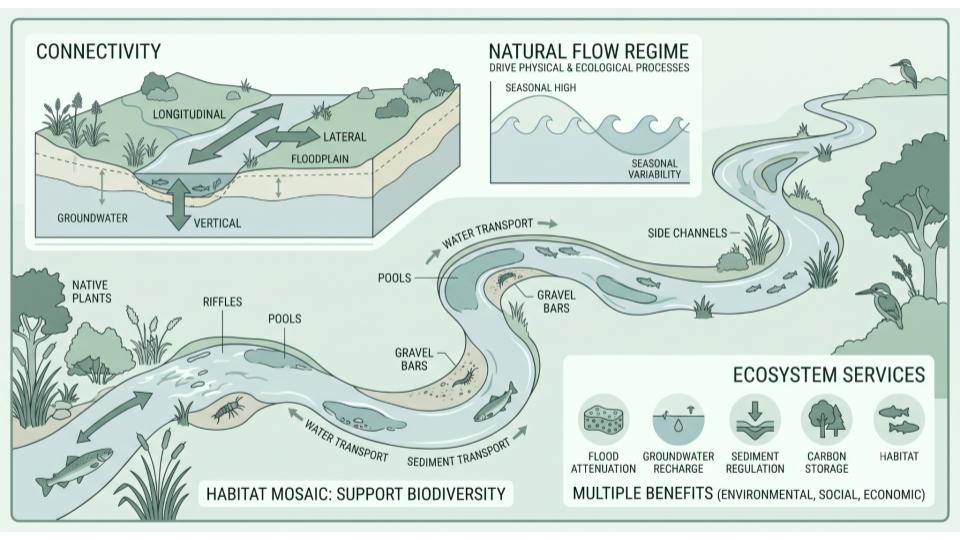
Healthy rivers are dynamic ecosystems whose ecological health depends on the continuous interaction between water, sediment, vegetation and surrounding landscapes. These interactions occur along the river (longitudinal connectivity), between the river and its floodplain (lateral connectivity), with groundwater (vertical connectivity), and over time as rivers naturally adjust to changing conditions.[1],[2],[3]
The natural flow regime—including seasonal floods, low flows and variations in discharge—drives many of the physical and ecological processes that shape river ecosystems.[4] Water transports sediment, creating a diverse mosaic of habitats such as riffles, pools, gravel bars and side channels that support fish, macroinvertebrates and aquatic plants.[5],[6] At the same time, the exchange of water, sediment, nutrients and organisms between rivers, floodplains and groundwater sustains ecological productivity, biodiversity and water quality.[7],[8],[3]
When these natural processes function together, rivers continually create and renew habitats, transport nutrients and organic matter, and maintain resilient ecosystems that can adapt to environmental change.[9],[2] Healthy rivers also provide essential ecosystem services, including flood attenuation, groundwater recharge, sediment regulation, carbon storage, clean drinking water and habitat for threatened species, delivering substantial environmental, social and economic benefits.[10],[11],[12]
How rivers have been altered
Over the past centuries, European rivers have been extensively modified to support navigation, hydropower, flood protection, agriculture and urban development.[13],[14],[15] Today, Europe’s rivers are among the most fragmented in the world, interrupted by more than one million artificial barriers—including dams, weirs, sluices, culverts and ramps—of which an estimated 150,000 to 200,000 are obsolete.[16],[17],[3]
These barriers interrupt river connectivity, preventing fish migration and disrupting the natural transport of sediment, nutrients and organic matter. Sediment becomes trapped upstream, while downstream river reaches experience erosion, riverbed incision and habitat degradation.[18],[19],[20]
At the same time, water abstraction, dams and flow regulation have altered natural flow regimes, reducing seasonal flood pulses and changing water temperatures and flow patterns.[18],[21],[22] Channel straightening, bank reinforcement, levee construction and the removal of woody debris have simplified river morphology and disconnected rivers from their floodplains, reducing habitat diversity and limiting natural river dynamics.[23],[15],[24]
The cumulative effects of these alterations have led to severe ecological degradation. Populations of migratory freshwater fish have declined by 93% since 1970, wetland and riparian habitats have been lost or degraded, and many European rivers still fail to achieve the good ecological status required under EU legislation.[25],[26],[27]
What Restoring River Functions Means
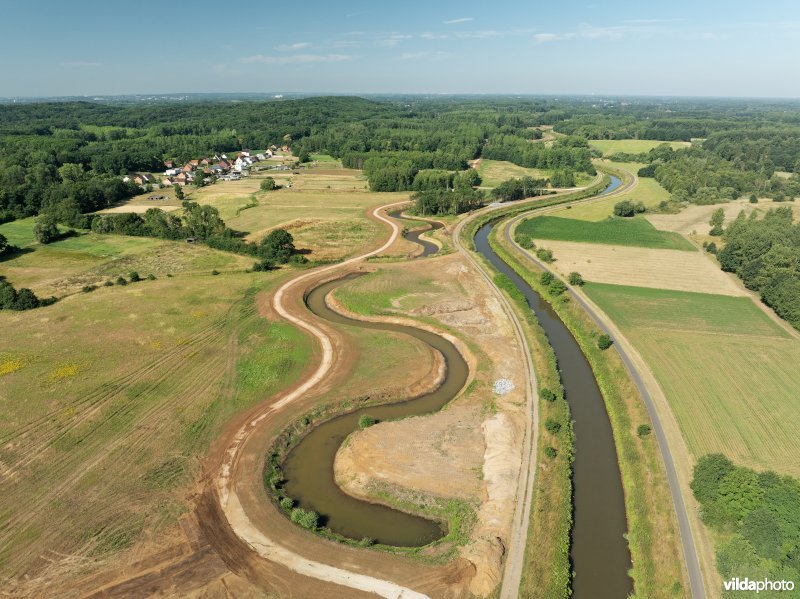
River restoration is increasingly shifting from repairing individual habitats towards restoring the natural processes that allow rivers to function as dynamic ecosystems.[28],[2],[29] Rather than creating static habitats, process-based restoration aims to recover the hydrological, geomorphological and ecological processes that sustain healthy rivers over the long term.
A key objective is to restore more natural flow regimes by implementing environmental flows that maintain seasonal low flows, channel-forming floods and natural flow variability. These processes sustain habitat diversity, transport sediment and provide essential ecological cues for aquatic species such as spawning fish.[4],[30],[22]
Restoring sediment continuity is equally important. Measures such as reducing sediment trapping by reservoirs, reintroducing gravel downstream of dams, sediment bypass systems and controlled flushing flows help re-establish natural sediment transport, rebuild riverbeds and improve spawning habitats.[31],[32],[20] Improving river connectivity is another central objective. Removing obsolete dams and weirs, adapting unavoidable barriers, restoring side channels and reconnecting rivers with their floodplains allow fish, sediment, nutrients and water to move freely through the river system.[33],[34],[16] Where appropriate, removing or relocating levees gives rivers more space to function naturally while increasing floodwater storage and restoring floodplain processes. Finally, restoring riparian vegetation and natural channel complexity strengthens ecosystem resilience. Re-meandering straightened rivers, restoring native riparian forests, adding large woody material and allowing rivers to reshape their channels create diverse habitats, improve water quality, regulate stream temperatures and support a rich diversity of aquatic and terrestrial species.[35],[36],[37],[38],[2]
By restoring these natural processes, river restoration contributes not only to healthier ecosystems but also to climate adaptation, flood risk reduction, improved water quality and more resilient landscapes. These multiple benefits underpin the objectives of European water, biodiversity and climate policy and make process-based restoration an essential component of sustainable river basin management.
Contribution to EU restoration objectives
The Nature Restoration Regulation (EU) 2024/1991 strengthens the existing EU policy framework for river restoration by introducing legally binding targets for restoring river connectivity and ecological functioning. The Water Framework Directive (2000/60/EC) already established the objective of achieving good ecological status for all surface waters, including improvements in hydromorphological conditions and river continuity. However, the WFD does not generally require the removal of barriers or the restoration of natural river dynamics unless these measures are necessary to achieve good ecological status.
The Nature Restoration Regulation builds upon this framework by introducing a stronger focus on restoring free-flowing rivers. It requires Member States to restore at least 25,000 km of free-flowing rivers by 2030, primarily through the removal of obsolete barriers and complementary measures that improve river connectivity. Restoring free-flowing rivers means re-establishing the natural movement of water, sediment and organisms throughout the river system. This includes improving longitudinal connectivity for fish migration, restoring sediment transport processes and reducing the fragmentation caused by dams, weirs and other artificial structures.
River connectivity is also closely linked to the connection between rivers and their surrounding landscapes. Where appropriate, restoration can include reconnecting rivers with their floodplains, removing or relocating levees, and restoring more natural flow patterns. These measures allow rivers to respond dynamically to changing conditions, improve habitat availability and increase resilience to climate change impacts such as floods and droughts. River restoration contributes directly to wider European climate and environmental objectives. The EU Climate Law (EU 2021/1119) establishes climate neutrality by 2050 and recognises the role of healthy ecosystems in climate mitigation and adaptation. The EU Adaptation Strategy (2021) promotes nature-based solutions that increase resilience to climate impacts. By restoring natural river processes, improving connectivity and allowing rivers more space to function, restoration measures can simultaneously support biodiversity, climate adaptation and sustainable water management.
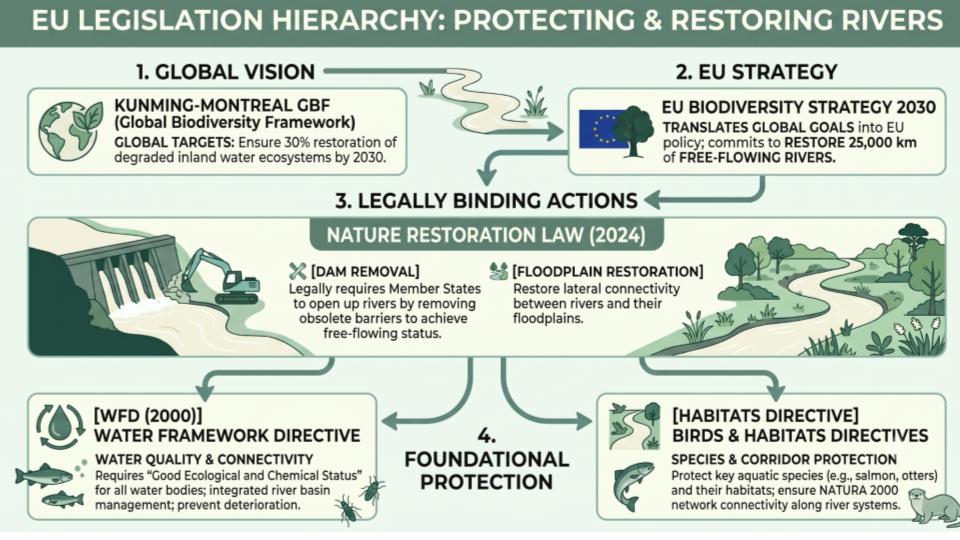
For policymakers and practitioners, this means that measures such as barrier removal, fish passage improvements, restoring sediment continuity, reconnecting floodplains and relocating levees can contribute to multiple EU objectives simultaneously. They support the achievement of ecological objectives under the Water Framework Directive, contribute to the conservation objectives of the Habitats Directive (92/43/EEC) and Birds Directive (2009/147/EC), and directly support the legally binding restoration targets of the Nature Restoration Regulation.
| Policy / Legislation | Relevance for Restoration |
|---|---|
| Water Framework Directive (2000/60/EC) | Establishes the objective of good ecological status for surface waters, including hydromorphological conditions and river continuity. Does not generally require barrier removal unless necessary to achieve good ecological status. |
| Nature Restoration Regulation (EU) 2024/1991 | Introduces legally binding targets requiring Member States to restore at least 25,000 km of free-flowing rivers by 2030, primarily through removal of obsolete barriers and measures improving river connectivity. |
| Habitats Directive (92/43/EEC) | Provides conservation objectives that river restoration measures — such as barrier removal and floodplain reconnection — can directly support. |
| Birds Directive (2009/147/EC) | Provides complementary conservation objectives supported by river restoration efforts. |
| EU Climate Law (EU 2021/1119) | Establishes climate neutrality by 2050 and recognises the role of healthy ecosystems in climate mitigation and adaptation, linking river restoration to wider climate objectives. |
| EU Adaptation Strategy (2021) | Promotes nature-based solutions that increase resilience to climate impacts such as floods and droughts, which river restoration directly supports. |
Key river functions to restore
Successful river restoration focuses on restoring natural processes rather than creating individual habitats. The functions below form the basis of process-based river restoration and are closely linked. Depending on the pressures affecting a river, projects may focus on one or several of these functions.
Where should I start?
What does your river show?
Select any that apply — the relevant functions below will be highlighted.
The five functions
Restore natural flow regimes
The natural flow regime determines how rivers function. Seasonal high and low flows shape river habitats, transport sediment, maintain water quality and provide essential ecological cues for fish, invertebrates and riparian vegetation.[4] Water abstraction, reservoirs and hydropower often alter these natural flow patterns.
Typical restoration measures
- Implement environmental flows (e-flows)
- Restore seasonal flow variability
- Reduce hydropeaking impacts
- Improve reservoir operation
- Re-establish flushing flows where appropriate
Key guidance
- European Commission – CIS Guidance Document No. 31: Ecological Flows in the Implementation of the Water Framework Directive (2015)
- REFORM Guidance and Decision Support Framework (Mosselman et al. 2015)
- National environmental flow standards (where available)
Restore sediment transport
Sediment transport is essential for maintaining healthy river morphology. Natural erosion, transport and deposition create gravel bars, riffles, pools and spawning habitats. Dams and channel modifications interrupt these processes, leading to riverbed incision, habitat degradation and coastal erosion.[41]
Typical restoration measures
- Restore sediment continuity
- Replenish gravel downstream of dams
- Use sediment bypass systems
- Apply controlled sediment flushing
- Reduce sediment trapping where feasible
Key guidance
- REFORM Policy Discussion Paper: Linking Environmental Flows to Sediment Dynamics (García de Jalón et al. 2016)
- River Restoration Centre (RRC) – Manual of River Restoration Techniques
- European SedNet Network (sediment management guidance)
Restore river connectivity
Healthy rivers depend on longitudinal, lateral and vertical connectivity. Rivers should allow the free movement of water, sediment, nutrients and organisms from their headwaters to the sea, between the river and its floodplain, and with groundwater systems.[1] Artificial barriers interrupt fish migration, disconnect floodplains and reduce ecological resilience.
Typical restoration measures
- Remove obsolete barriers
- Install nature-like fish passes where removal is not possible
- Reconnect side channels and oxbow lakes
- Set back or remove levees
- Restore river–floodplain connectivity
Key guidance
- European Commission – Barrier Removal for River Restoration (2021)
- Dam Removal Europe (technical guidance, case studies and prioritisation tools)
- JRC – Criteria for Free-Flowing Rivers
- AMBER Barrier Atlas (European barrier database)
Restore natural channel dynamics
Rivers are naturally dynamic systems that continuously reshape their channels through erosion and sediment deposition. Channelisation, bank reinforcement and straightening reduce habitat diversity and prevent rivers from adapting to changing conditions.
Typical restoration measures
- Re-meander straightened rivers
- Remove hard bank protection
- Restore secondary channels
- Introduce large woody material
- Allow natural channel migration where possible
Key guidance
Restore riparian vegetation
Riparian vegetation is a key component of healthy river systems. Native trees and shrubs stabilise banks, regulate water temperature through shading, filter nutrients, provide habitat and naturally supply large wood to the river.[46]
Typical restoration measures
- Restore native riparian woodland
- Establish riparian buffer strips
- Reduce livestock pressure
- Restore alluvial forests
- Control invasive plant species where necessary
Key guidance
Useful European resources
The following platforms provide practical guidance, case studies and technical tools for river restoration projects:
| Resource | Main focus |
|---|---|
| River Restoration Centre (RRC) | Restoration techniques, manuals and case studies |
| European Centre for River Restoration (ECRR) | European knowledge exchange and best practices |
| Dam Removal Europe | Barrier inventories, technical guidance and case studies |
| REFORM | Process-based river restoration guidance and decision support |
| AMBER Barrier Atlas | European inventory of river barriers |
| Natural Water Retention Measures (NWRM) Platform | Nature-based solutions and catchment restoration |
| IUCN Nature-based Solutions | NbS standards and implementation guidance |
| SER International | International restoration standards and monitoring guidance |
- Ward, J. V., & Stanford, J. A. (1989). Riverine ecosystems: The influence of four-dimensional connectivity. Journal of the North American Benthological Society, 8(1), 2–15. ↑ Connectivity types ↑ Restore river connectivity function
- Beechie, T. J., Sear, D. A., Olden, J. D., et al. (2010). Process-based principles for restoring river ecosystems. BioScience, 60(3), 209–222. ↑ Connectivity types ↑ Habitat renewal ↑ Process-based restoration ↑ Riparian restoration
- Stoffers, T., et al. (2024). River Restoration and Connectivity in Europe. ↑ Connectivity types ↑ Exchange processes ↑ Barriers
- Poff, N. L., Allan, J. D., Bain, M. B., et al. (1997). The natural flow regime. BioScience, 47(11), 769–784. ↑ Flow regime ↑ Environmental flows ↑ Restore natural flow regimes function
- Wolter, C., Buijse, A. D., Parasiewicz, P., et al. (2013). The importance of hydromorphological processes for river restoration. Hydrobiologia, 712, 199–210. ↑ Habitat mosaic
- Rinaldi, M., Surian, N., Comiti, F., & Bussettini, M. (2015). A methodological framework for hydromorphological assessment. Aquatic Sciences, 77, 481–499. ↑ Habitat mosaic
- Heiler, G., Hein, T., Schiemer, F., & Bornette, G. (1995). Hydrological connectivity and floodplain ecology. Regulated Rivers: Research & Management, 11, 231–245. ↑ Exchange processes
- Ward, J. V. (1998). Riverine landscapes: Biodiversity patterns, disturbance regimes and aquatic conservation. Biological Conservation, 83, 269–278. ↑ Exchange processes
- Jungwirth, M., Muhar, S., & Schmutz, S. (2002). Re-establishing and assessing ecological integrity in riverine landscapes. Freshwater Biology, 47, 867–887. ↑ Habitat renewal
- Costanza, R., d'Arge, R., de Groot, R., et al. (1997). The value of the world's ecosystem services and natural capital. Nature, 387, 253–260. ↑ Ecosystem services
- Richter, B. D., et al. (2010). Lost in development's shadow: The downstream human consequences of dams. Water Alternatives, 3(2), 14–42. ↑ Ecosystem services
- ENRR. (2023). The Economic Benefits of Nature Restoration. European Network for Rural Development. ↑ Ecosystem services
- Brookes, A. (1998). River Channel Restoration: Guiding Principles for Sustainable Projects. John Wiley & Sons. ↑ River modification
- ECRR. (2000). The European Centre for River Restoration: River Restoration in Europe. ↑ River modification
- Tockner, K., Uehlinger, U., & Robinson, C. T. (Eds.). (2009). Rivers of Europe. Academic Press. ↑ River modification ↑ Channel simplification
- Belletti, B., Garcia de Leaniz, C., Jones, J., et al. (2020). More than one million barriers fragment Europe's rivers. Nature, 588, 436–441. ↑ Barriers ↑ Connectivity restoration
- AMBER Consortium. (2022). The AMBER Barrier Atlas. Adaptive Management of Barriers in European Rivers. ↑ Barriers
- Petts, G. E. (1984). Impounded Rivers: Perspectives for Ecological Management. John Wiley & Sons. ↑ Sediment disruption ↑ Flow regulation
- Ligon, F. K., Dietrich, W. E., & Trush, W. J. (1995). Downstream ecological effects of dams. BioScience, 45(3), 183–192. ↑ Sediment disruption
- De Jalón, D. G., Vizcaíno, P., Casas-Mulet, R., & Magdaleno, F. (2016). River restoration and sediment management in regulated rivers. International Journal of River Basin Management. ↑ Sediment disruption ↑ Sediment continuity
- Poff, N. L., & Hart, D. D. (2002). How dams vary and why it matters for the emerging science of dam removal. BioScience, 52(8), 659–668. ↑ Flow regulation
- Cowx, I. G., et al. (2013). Water Resources, Hydrological Alterations and Fish Conservation. Wiley-Blackwell. ↑ Flow regulation ↑ Environmental flows
- van Urk, G., & Smit, H. (1989). River Restoration in Europe. Rijkswaterstaat. ↑ Channel simplification
- Knox, R. L., et al. (2022). River channel simplification and ecological consequences. River Research and Applications. ↑ Channel simplification
- World Fish Migration Foundation. (2020). Living Planet Index for Migratory Freshwater Fish. ↑ Ecological decline
- EEA. (2023). Europe's State of Water 2023. European Environment Agency. ↑ Ecological decline
- LRE. (2024). Landscape Restoration in Europe: State of Restoration Report. ↑ Ecological decline
- Sear, D. A. (1994). River restoration and geomorphology. Aquatic Conservation: Marine and Freshwater Ecosystems, 4, 169–177. ↑ Process-based restoration
- Addy, S., Cooksley, S., Dodd, N., Gilvear, D., Roni, P., & Wilkes, M. (2016). River Restoration and Biodiversity: Nature-based solutions for restoring river channels and floodplains. IUCN National Committee United Kingdom. ↑ Process-based restoration
- Acreman, M., & Ferguson, A. J. D. (2010). Environmental flows and the European Water Framework Directive. Freshwater Biology, 55(1), 32–48. ↑ Environmental flows
- White, R. (2001). Evacuation of Sediments from Reservoirs. Thomas Telford. ↑ Sediment continuity
- Okano, M. (2004). Sediment bypass systems in reservoir management. International Journal of Sediment Research. ↑ Sediment continuity
- Bednarek, A. T. (2001). Undamming rivers: A review of the ecological impacts of dam removal. Environmental Management, 27(6), 803–814. ↑ Connectivity restoration
- O'Hanley, J. R. (2011). Open rivers: Barrier removal planning and fish passage restoration. Journal of Environmental Management, 92, 3112–3120. ↑ Connectivity restoration
- Binder, W. (2000). Rivers in the landscape: Stream restoration and management. Water Science and Technology, 42(1–2), 1–9. ↑ Riparian restoration
- Jeffries, M., Mills, D., & Mills, D. (2003). Freshwater Ecology: Principles and Applications. John Wiley & Sons. ↑ Riparian restoration
- Brooks, K. N., Ffolliott, P. F., Gregersen, H. M., & DeBano, L. F. (2003). Hydrology and the Management of Watersheds (3rd ed.). Iowa State Press. ↑ Riparian restoration
- Sharpe, W. E., & James, B. R. (2006). Riparian Buffer Management. Penn State University. ↑ Riparian restoration
- García de Jalón, D., Bussettini, M., Rinaldi, M., Grant, G., Friberg, N., Vezza, P., Cowx, I. G., Magdaleno Más, F., & Buijse, T. (2016). Linking e-Flows to sediment dynamics. Water Policy, 19(2), 358–375. REFORM Deliverable D7.7 Policy Discussion Paper No. 3, EU FP7 Project REFORM. ↑ Restore sediment transport function
- González del Tánago, M., Martínez-Fernández, V., Aguiar, F. C., Bertoldi, W., Dufour, S., García de Jalón, D., Garófano-Gómez, V., Mandzukovskih, D., & Rodríguez-González, P. M. (2021). Improving river hydromorphological assessment through better integration of riparian vegetation: Scientific evidence and guidelines. Journal of Environmental Management, 292, 112730. ↑ Restore riparian vegetation function